
Spider Solitaire has a reputation for being an unforgiving card puzzle, but the single-suit version changes the equation completely. By using 104 cards that all belong to the Spade suit, Spider Solitaire 1 Suit removes suit management from the board. You can focus purely on sequence building, column clearing, and uncovering hidden cards without getting trapped by mismatched colors.
If you are new to the Spider family or find classic four-suit games overwhelming, starting with one suit builds your tactical foundation faster than any other variant.
Play Spider Solitaire 1 Suit Online
100% Free. Play directly in your browser in full screen mode, no download or registration required.
Play Game NowThe Mechanics of Single-Suit Play
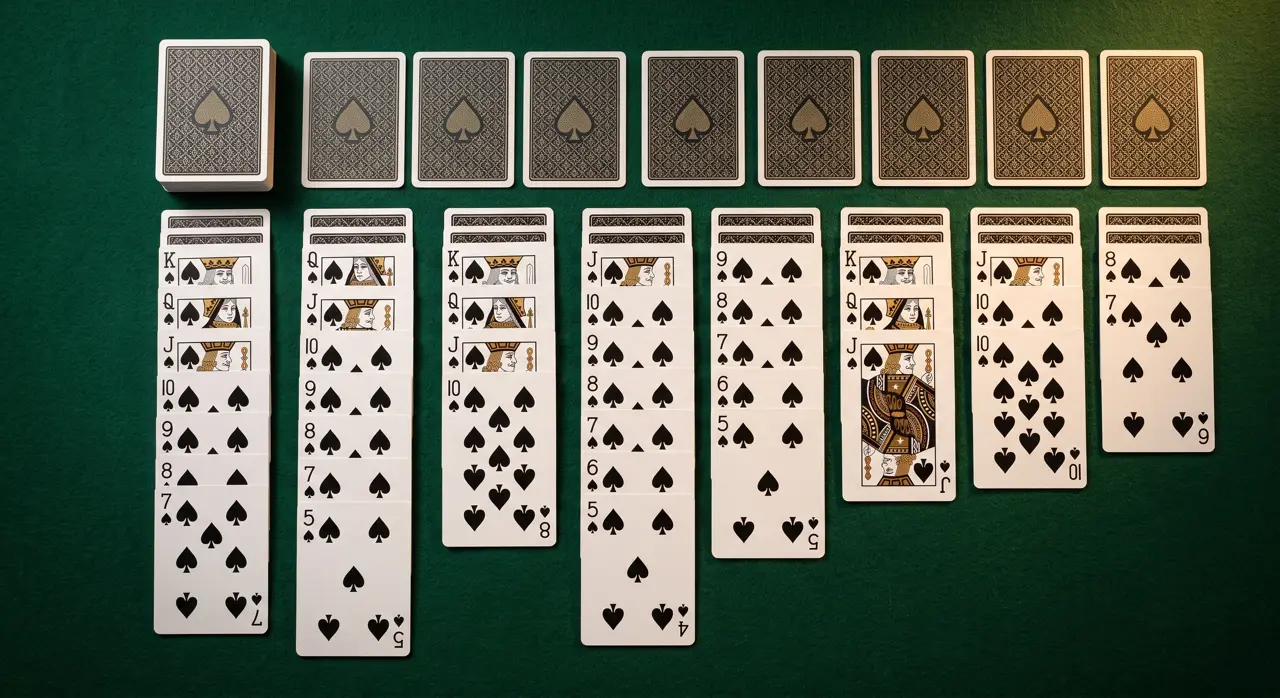
Understanding why single-suit Spider is so approachable starts with its board layout. Even though you play with two full decks of cards, every single card functions identically.
| Board Characteristic | Single-Suit Specification |
|---|---|
| Total Cards | 104 cards (8 identical sets of Ace through King in Spades) |
| Tableau Setup | 54 cards dealt across 10 columns (first 4 columns have 6 cards, remaining 6 have 5 cards) |
| Stock Pile | 50 cards face-down, dealt in 5 rounds of 10 cards |
| Sequence Rule | Descending order from King down to Ace |
| Movable Group | Any connected descending sequence can be moved together |
| Average Win Rate | 95% to 99% for players who plan their moves |
Because every card shares the same suit, every descending stack you build is a valid group. In multi-suit versions, placing a Spade on a Heart creates a split column that you cannot move as a unit. In Spider Solitaire 1 Suit, every run of King-to-Ace is mobile from top to bottom.
Why Beginners Should Start with One Suit
Playing single-suit Spider teaches core solitaire mechanics while keeping frustration low. Here are the main reasons why this variant is the ultimate starting ground:
1. High Solvability Builds Confidence
Computer simulations show that nearly 100% of single-suit deals can be won with correct play. Unlike Klondike, where unwinnable shuffles happen frequently, losing a game of single-suit Spider is almost always due to tactical missteps rather than bad card distribution. This high win rate gives immediate positive feedback as you refine your technique.
2. Full Column Mobility
In two-suit or four-suit games, mixed columns block access to hidden cards underneath. In the single-suit version, you never have to worry about broken sequences. If you see a card you need, you can shift the entire stack sitting on top of it as long as the numbers descend correctly.
3. Master Empty Column Management
Empty columns are the most powerful tool in Spider Solitaire. Single-suit play lets you experience the value of empty slots without the stress of managing suit conflicts. You quickly learn how to use open spaces as temporary sorting pads to organize long runs.
4. Smooth Transition to Harder Variants
Once you master single-suit patterns, stepping up to Spider Solitaire 2 Suits feels natural. You will already know how to manage tableau depth, clear face-down cards, and timing stock draws. For deeper tactical breakdowns, read our Spider Solitaire 1 Suit strategy guide.
Simple Strategies to Win Consistently
Even though single-suit Spider is forgiving, following these basic habits ensures high scores every game:
- Clear Shallow Columns First: Target the columns on the right side of the tableau that start with only 5 cards. Revealing hidden cards here gets you empty slots faster.
- Expose Face-Down Cards Before Drawing: Always exhaust all available tableau moves before clicking the stock pile. Dealing 10 new cards buries your progress.
- Keep Stacks Organized by Rank: Try to build continuous runs from King down to Ace in a single column rather than scattering partial sequences across multiple columns.
- Reserve Open Slots for Kings: When you create an empty column, fill it with a King or a long sequence starting with a King to build complete 13-card runs.