
Moving from single-suit Spider to two suits is the most satisfying step in solitaire card games. While single-suit play teaches board awareness, two-suit Spider introduces true strategic choice. By mixing Spades and Hearts across your columns, the game forces you to balance short-term card moves against long-term column mobility.
Learning how to navigate this increased complexity turns two-suit Spider into a deeply rewarding game where skilled planning yields impressive win rates.
Play Spider Solitaire 2 Suits Online
100% Free. Play directly in your browser in full screen mode, no download or registration required.
Play Game NowThe Mechanics of Two-Suit Spider
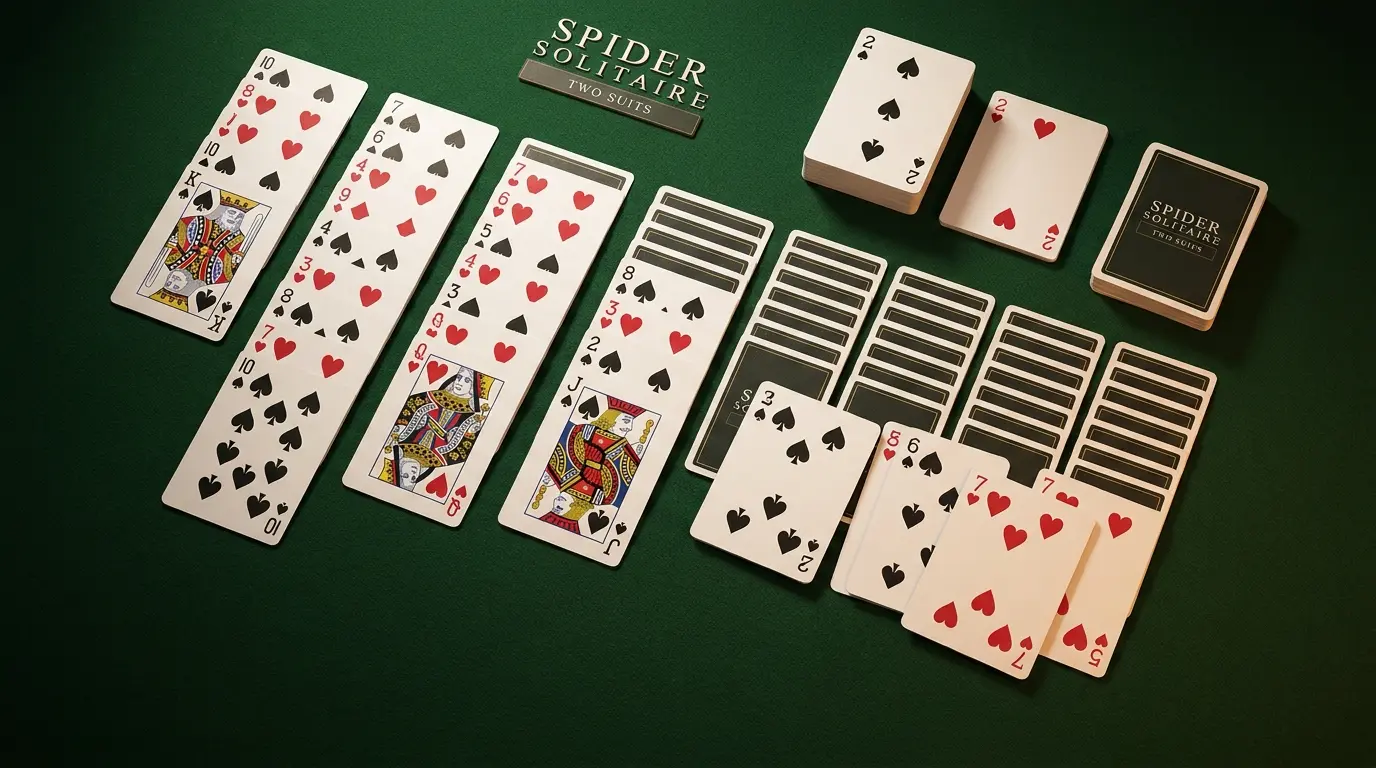
In two-suit Spider Solitaire, you work with 104 cards divided equally between two suits—52 Spades (black) and 52 Hearts (red).
| Rule & Metric | Specification |
|---|---|
| Deck Composition | 104 cards (4 sets of Spades, 4 sets of Hearts) |
| Tableau Layout | 54 cards dealt across 10 columns |
| Stock Deals | 50 cards remaining in stock, dealt 10 at a time |
| Card Stacking | Any card can be placed on a card 1 rank higher regardless of suit |
| Group Movement | Only same-suit descending sequences can be moved as a unit |
| Estimated Win Rate | 60% to 80% with strategic planning |
The key rule difference lies in group movement. You can place a 7 of Hearts on an 8 of Spades to expose a face-down card. However, that stack is now split by suit. You cannot move the 8-7 group together until you separate them or complete the Spade run elsewhere on the board.
Strategic Shifts for Two-Suit Mastery
To beat Spider Solitaire 2 Suits consistently, adjust your mindset from casual sorting to active column management:
1. Same-Suit Moves Take Priority
Whenever you have a choice between placing a card on a matching suit or an opposite suit, pick the matching suit. A continuous sequence of Spades remains fully mobile. A mixed stack of Spades and Hearts locks cards underneath until you clean it up.
2. Treat Mixed Moves as Temporary Sacrifices
Mixing suits is not a mistake—it is an essential tactic. Stacking a red Heart on a black Spade is often the only way to uncover hidden cards. The trick is to treat mixed stacks as temporary measures. Work to untangle them as soon as open columns become available.
3. Build Temporary Sorting Pads
When you clear a column, do not fill it immediately with a random card. Use open slots as sorting pads to unstack mixed sequences. By moving top cards back and forth into empty space, you can separate Spades from Hearts and rebuild single-suit runs.
4. Prepare for Stock Pile Deals
Before clicking the stock pile, make sure your tableau is as clean as possible. Dealing 10 new cards puts a new card on top of every column, burying your organized runs. Consolidate your stacks before drawing so that stock cards do not trap your best sequences.
5. Transitioning to Four Suits
Once you consistently achieve win rates over 50% in two-suit play, you will be fully prepared for Spider Solitaire 4 Suits, the ultimate test of card-sorting logic. For additional tactical breakdowns, check our detailed Spider 2 Suits winning guide.